

What is peace?
The dictionary has several definitions, which are:
- non-warring condition of a nation
- an agreement or treaty between warring or antagonistic nations, groups, etc.
- freedom of the mind from annoyance, distraction, anxiety over an obsession, etc.
The type of peace I refer to is “C”.
You see, we can’t control the tumult in others. Yes, there will be times in your life when others will war upon you with envy, bitterness, jealousy, malice, wrong-doing, resentment, and betrayal. You can’t stop them. You can only walk away. You may seek help with how to cope, how to repair damages, or you may seek help to stop abuse, but you can’t force others to change for your betterment, or for any betterment.
I have stood up for my beliefs and convictions on many occasions. I have let integrity guide me on many occasions with the unfair result of retaliation. There have been many times when I have let that retaliation beat me down with grief. But what I realize now is that to allow myself to experience grief is to let my enemy win. But winning is not the primary reason to fight for inner peace.
The primary reason to fight for inner peace is self-love, self-respect, and positive mental health.
Each human being will take their turn being slighted, being abused, and experiencing tumult. You must realize that this is part of the struggle of your human existence, and the nature of humanity. In this revelation, you will find wisdom. In your wisdom, you will also find your peace.
And outside human behavior, ventures will fail, economies — both individual and societal — will crumble. Let the world fall around you but stand strong. Your time of triumph will come around again. Be patient. Be at peace.
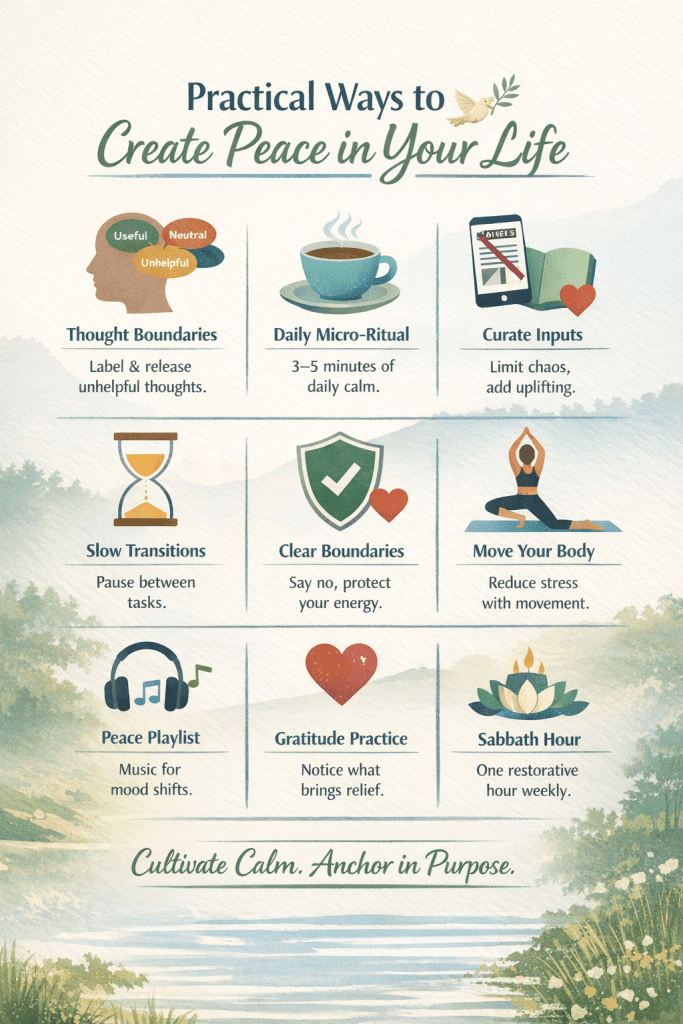
In the meantime, here is a practical and comprehensive list of ways to employ peace for your daily life.
- Reduce mental noise by creating “thought boundaries.”
- Not every thought deserves your attention. Practice labeling thoughts as useful, neutral, or unhelpful — then release the ones that don’t serve your direction.
- Build a daily “micro‑ritual” that signals calm.
- Just 3–5 minutes.
- Examples: grounding breath, stretching, stepping outside, or a single cup of tea without multitasking.
- Consistency matters more than duration.
- Curate your inputs.
- Peace is often a subtraction problem. Therefore, LIMIT things like chaotic news cycles, draining conversations, cluttered digital spaces/home spaces, environments that create stress and ADD things like uplifting voices/sounds, intentional learning, pockets of brief, quiet time throughout your day.
- Practice “slow transitions” instead of multi-tasking chaos.
- Instead of jumping from task to task, insert a 30–60 second pause to reset your nervous system.
- This alone can reduce overwhelm dramatically.
- Single‑tasking is a form of peace.
- Your brain performs better, and your stress response stays lower.
- Create physical order in one small zone.
- A peaceful environment cues a peaceful mind.
- Pick one: your desk, your nightstand, your car, your kitchen counter.
- Maintain it daily — it becomes an anchor.
- Use compassionate self‑talk as a discipline.
- Peace grows when your inner voice stops acting like an adversary.
- Replace self‑criticism with coaching language such as, “What’s the next right step I can take?”
- Protect your energy with clear boundaries.
- Say no without apology.
- Say yes with intention.
- Peace is often found in the space you refuse to fill with obligations.
- Move your body in ways that regulate your nervous system.
- Walking, yoga, strength training, stretching — anything that brings you back into your body.
- Movement metabolizes stress.
- Create a “peace playlist” for emotional regulation.
- Music is one of the fastest ways to shift your physiological state.
- Use it strategically: morning grounding, mid‑day reset, evening wind‑down.
- Practice gratitude in a way that feels real, not forced.
- Instead of making a list of reasons to be grateful, try:
- “What brought me relief today?”
- “What felt like support?”
- “What made me exhale?”
- Build a weekly “Sabbath hour.”
- One hour where you unplug, slow down, and do something restorative.
- This becomes a rhythm your nervous system learns to trust.
- Christian religions practice an entire day, which is prescribed by God for rest.
- Surround yourself with people who regulate (not dysregulate) your energy.
- Peace is relational.
- Choose people who bring steadiness and calm, not chaos.
- Limit your time spent with ‘chaotic others’. As the Bible states, “Bad company corrupts good character.” (1 COR 15:33)
- During times when you must interact with ‘irrational others’, then consider it an exercise-opportunity to develop tolerance, self-control, compassion, and boundary setting.
- Practice acceptance where control is impossible.
- Peace grows when you stop wrestling with what you cannot influence. Shift your focus to what is within your reach.
- Anchor yourself in purpose.
- When your life aligns with your values, peace becomes a byproduct.
- Purpose quiets the noise.
- If you haven’t yet identified your core values, then consider enlisting the help of a mental health coach or take a Myers-Briggs Personality Test for free at www.16personalities.com.
Peace doesn’t arrive through perfection or control; it grows quietly in the spaces we protect. When we choose to pause, breathe, and simplify, we reclaim the steadiness that chaos tries to steal. Each small act of calm — a mindful breath, a boundary honored, a moment of gratitude — becomes a seed of peace that ripples outward. Amidst the noise of the world, may you remember that serenity is not found elsewhere; it’s cultivated within.




 New Zen Vigor
Leave a comment